Posts tagged: website

Three Reasons To Add A Blog To Your Website
If you’ve built a well-designed website for your small business, congratulations! You’re already ahead of the competition. Good small business website design is very important, yet browsing the Internet, I often can’t help but notice how poorly designed many websites are. A clean, bold design, easy navigation and high-quality content, along with basic search engine optimization of your website’s copy and title tags, will do wonders for your website and will help you strengthen your brand and establish yourself as a reputable business.

Now to the bad news. Just a decade ago, a great website was all you needed to establish your business online and to impress prospects. But things have changed dramatically over the past few years. Having a great, well-designed website isn’t enough anymore – you now need to have an interactive, social online presence. Customers, clients and prospects expect more these days from their online experience. They have come to expect interaction – they want to interact with you online, or at least have the option to do so.

To enable prospects to interact with you, you need to be active in social media, and one of the oldest forms of social media is also one of the best – blogging. Here are the three main reasons you should add a blog to your small business website – today.

1. Strengthening your brand. A well-written blog transforms your website from static to dynamic. It creates a vibrant website that keeps getting updated with fresh content, which gives visitors a reason to come back and also gives search engines a reason to crawl your website more often (more on SEO benefits in the next paragraph). You can use a blog to provide your visitors with new info, tips and ideas; to create a buzz around your website by posting contests and giveaways; and to give your customers and prospects a place where they can interact with you through voting, polls and comments.

2. SEO benefits. A blog gives you a wonderful opportunity to enrich your website with your main keywords. This is especially important for e-commerce websites that typically have very little content. When search engines are crawling your website, trying to index it correctly, they need to have something to work with – they need text that will tell them what your website is about and what are your main keywords. While your website’s URL and title tags provide search engines with the basic info, a blog reinforces that information and, overtime, can help you to rank better for many different keywords.

3. Your competitors are doing it. Even if you’re not convinced that your website needs a blog, but your competitors are adding blogs to their websites, this should be a good enough reason to add a blog too, especially if you know that customers in your space are participating in social media and reading blogs. If your competitors seem more up-to-date than you are, if their website is more fun and interesting, prospects will not hesitate to choose them over you.

Professional Website Design: Is It Worth The Investment?

For a small business, every dollar counts. You think long and hard before you spend – and that’s the way it should be. But while there are certainly many unnecessary expenses that you should avoid, or cut from your budget, professional Web design is not one of them. Here are the reasons:

You Need A Strong Online Identity

As a long-term strategy, you want to separate yourself from the crowd and have your own online identity. You should have a unique logo, a unique website, and unique business cards. If you use do-it-yourself Web design templates, you may be saving money in the short term, but you are hurting your business’ chances of leaving an impression. Don’t let your business look just like thousands of other businesses. The right design can make the difference between a struggling business and a smashing hit.

Professional Web Design CAN Be Affordable

Many small business owners mistakenly assume that they simply cannot afford small business website design. But this is untrue. You should find a designer who specializes in Web design for small businesses because this type of designer will be more sensitive to your budget constraints than Web designers who typically work with corporations. In addition, you should realize that you can start with a very small website, which would cost considerably less – all you need are a few Web pages and a strong design. You can always add more pages and functions later, as your business grows and your budget expands.

Built-In Search Engine Optimization

I’ve seen countless websites that were built by their owners using a template and that are not optimized for search engines. This means that no one is going to find these websites! Typically, after a few months, they realize that they keep working on their website, adding content and tweaking the design, but it’s all worthless because their website does not appear in search engine results. A good Web designer will make sure that your site is optimized for search engines, and will also make sure that the design elements are light enough that the site loads fast – people on the Web are impatient with slow-loading sites. In fact, Google has recently announced that it now incorporates website load time as part of its ranking system.

Save Time, Save Money

Your time is worth money. The time you spend on fiddling with your website design could be spent doing something else – something more productive, something you know how to do such as growing your business. You may think that you are “saving” money by not hiring a professional to do your Web design. But are you really saving if it means long hours of working on your site design, hours that never translate into the visual image you have in mind, simply because you’re not a professional? In today’s complex world, it makes sense for each of us to do what we specialize in. For you it means growing your business, and letting design professionals take care of your website design.

The Wrong Website Can Kill Your Business

First impressions are important – I’m sure you’ll agree. And your website is the first impression that people get about your business. The wrong website design can essentially kill your business by driving your web visitors away, causing them to immediately bounce back and go directly to your competition.

Better make a good first impression! But how? Here are a few small business website design tips.

1. Avoid clutter. A cluttered website is confusing to users, who don’t know where to click or what to do and so they tend to click away. This could be good if your goal is to make money from ads on your site, because the path out of a site is often through clicking on an ad, but if your goal is to encourage your visitors to stay and browse, aim for a clean, simple design and make it easy for your visitors to navigate your site.

2. What is your website about? What do you offer? If a visitor can’t answer this question immediately, they will click away. Ask friends and family members to take an objective look at your website and to tell you if they can tell right away what it’s about.

3. Make it fast. A slow-loading website is painful for users. It’s one of the main reasons users give up on a site. Make sure your website doesn’t contain heavy elements that would slow it down, and use a third-party tool to test load time for your site. The fact that it loads fast for you doesn’t necessarily reflect other users’ experience.

4. Content IS king. Yes, this old cliché is true. Your website content needs to offer value to readers. It needs to be well written, free of typos and engaging. Even if your site loads fast and is clean and professional looking, users WILL bounce off if they discover that your content does not offer them any value.

5. Avoid anything that could be annoying or distracting to users, including flash, auto-loading sound or blinking text. Even if you’re trying to make people click on ads, remember that being assaulted by blinking, moving, loud ads will most likely cause people to close the page rather than click on those annoying ads. Ads actually work best if they blend into your content and offer value to your readers, just like your main content does.

6. Minimize clicking. Make navigating your site and getting to the important pages easy. If people have to click through 6 pages to get to what they were looking for, they will likely just abandon your site.

7. Make it readable. Even if your text is great, people won’t read it unless it’s easy to read. Make sure your font is large enough, web-friendly, and space your lines. It’s also important to keep your lines short and to avoid using dark text on a dark background, or light text on a light background.

8. Link correctly: include internal links whenever they’re relevant, so visitors can discover more parts of your site. Make sure internal links, unlike external links, open in the same browser window – users will resent having several browser windows open, all of them from your site. When you link to other sites, do make sure they open in a new window.

If you’re not sure how user friendly your site is, it’s always a good idea to ask friends and family members to take a look and give you an honest feedback. If you’re planning, or hoping to earn money from your site, using the services of a professional web designer is one of the most important investments you will ever make in your business.

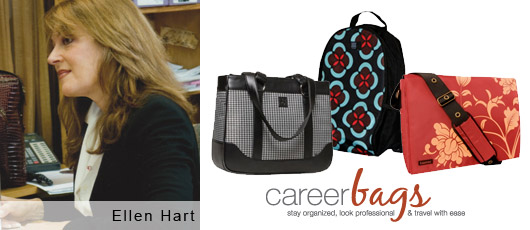
Small Business Profile: Ellen Hart, Careerbags.com

careerbags
(310) 491-1460 ellen@careerbags.com www.careerbags.com

Tell us your story of why and how you decided to start your own business.
In 1990 I was unable to find a business case that fit my needs as a professional woman. I designed a collection and sold it to a major luggage company called Hartmann Luggage. I stayed involved in the sales and marketing of the collection for many years but eventually went on to create other products. Four years ago some of the retailers that I dealt with called and asked to have the collection redesigned and updated because there were no lines out there for women professionals and students. I researched the Internet and found some fantastic designers and decided that there were plenty of options out there but not one great place to find them all. I grabbed the domain name Careerbags and started my business a year later.

How would your customers describe your business?
Great selection, well organized and fun place to shop. Grateful to find a store that carries such a wide variety of products specifically for women.

What’s unique about your business, how do you differ from your competitors?
We focus on the professional woman, listen to their ideas and suggestions and follow the fashion and technology trends. We are always available to guide them over the phone and be a personal shopper to help them find just the right product. We like to hear about what their career, personal style, what they carry to help them find the perfect solution.

What’s your most popular product?
17” laptop bags are flying off the shelves and we just cannot keep them in stock.

How do you market your business?
We have several blogs like our www.laptopbaglifeline.com and we use social networking like twitter and facebook, outreach to other bloggers and we wait for our HARO (help a reporter out) emails to show up and pounce on any opportunity for PR.

What role does your website play in your business?
That is my business and without keeping it updated and fresh and working with Design Leap to find out what we can do to make it better on a weekly basis, I wouldn’t have much of a business.

What would you say to small businesses who currently don’t have a website or have neglected it?
It is vital and the most cost effective and expedient way to reach their market what ever that may be.

Anything additional you want to tell us about your business that we don’t know yet?
Visit the website and see for yourself and I am always open for ideas. Life on the Internet changes everyday and I cannot wait to see what’s next!

Is It Time To Redesign Your Website?

I recently talked with a potential client whose entire website is based on Flash. Flash websites used to be extremely popular during the 1990s, but have since become pretty much obsolete, especially because it is very difficult to optimize these limited textual content websites for search engines. Take a look at this article to learn more about what is Flalsh and is it suitable for your business.

The client now wants a modern, content-rich, non-Flash website that search engine spiders can actually crawl. This is a very good reason to do a website redesign, which got me thinking about several more reasons why you should redesign your website.

Your Website Looks Old

The web is fast-paced. It is constantly updating and changing. Web users expect to see fresh, interesting design. They want websites that are user friendly, easy to navigate, and fast-loading. Above all, they want websites that catch their eye and make them want to stick around. Now take a long, hard look at your small business website and ask yourself: does it provide all of the above? If your website is older than five years and you’ve never redesigned it, chances are it has an outdated look and feel that is not going to appeal to users. And with so many options on the web these days, users can simply bounce off and go to the next website.

Outdated Content

Your website’s content needs to be constantly updated to stay fresh and interesting. Yes, content is king, which means you cannot just slap some content on your website and forget about it. The best way is to attach a blog to your website and keep adding new content for your visitors.

Search Engine Optimization

If you’re having trouble getting your website to rank well in search engines for your chosen keywords, even though you have optimized your tags and your content, you should consider a website redesign. Search engine spiders have a harder time crawling old websites than crawling new, modern websites.

Competition is Redesigning

Whatever your competitors are doing, you don’t want to lag behind. If they start using social media, you should do the same. If they are lowering prices or giving special offers, you should probably do the same. And if they are redesigning their websites, you should redesign yours too. Being the only old-looking website when the competition has fresh, modern websites will hurt your small business.

Low Conversion Rates

If you find that your conversion rates are low, or that people who land on your website quickly bounce off, there’s something about your website that is turning visitors off. A website redesign, whether changing design elements, functionality or content, is probably a good idea.

Outdated Design Elements

Some web design elements are considered outdated and should be changed regardless of any other consideration or problem. Flash, as pointed above, Frames and Tables were all used for web design in the past but are now considered obsolete and make your website difficult to maintain and to update. The same is true for features such as Intro Pages (those pages that load before users get access to the home page) – these are annoying to web visitors and could cause them to click away.

Remember that small business website redesign, where you hire a designer to redesign an existing website, is at least as complex as creating a website from scratch. Make sure you find a website designer that you are comfortable with and are able to trust. For more on choosing the right web designer, check out this article on What to Look for in a Web Designer.

Enhanced by Zemanta

Small Business Website: Should You Use Your Own Name And Photo?

When working on your small business website design, one of the main questions you will need to answer is the question of your website’s identity. Assuming you are a small business, maybe even a one-person-shop, do you disclose this on your site, or do you pretend to be a bigger business than you really are?

This is one area where there are no hard and fast rules, and where either approach can work, so each business should do what feels right to them.

The “Human” Route

Establishing yourself as a small, family-owned business, for example, can have a big advantage when it comes to giving you credibility – especially in social media (which should be an integral part of your marketing campaign). Social media participants typically expect to have conversations – the last thing they want when they access their Twitter account is to find that the people and businesses they follow are trying to sell them stuff.

Now, of course you ARE trying to sell them stuff! You’re a business after all. But the more subtle you are about it, the more you humanize your online presence, the more receptive social media participants will be to accepting you into their networks. The more forthcoming you are about “hey, I’m here to sell,” the less people will be inclined to follow – unless your product is truly one of a kind, awesome and everyone wants it (in which case you’ve made it! Congratulations).

In the above scenario, using your name and photo on your website and in your social media accounts and emphasizing the human side of your business can be a very smart move. One of my clients, for example, chose to say on their website’s “About” page and in their Twitter bio “we are a small, woman-owned business.” This humanizes them and makes it easier for people, and especially for other women, to connect with them.

Of course, you shouldn’t lie about your true identity! If you’re not a woman, then you can’t say “woman-owned” and if you’re not a family-owned business, then you shouldn’t use that line either. But whatever your identity, you can find an angle that would humanize you and make it easier for people to connect with you.

The “Corporate” Route

Another option for small businesses who are trying to establish their online identity is to go corporate – to establish themselves as large (larger than they are), highly professional businesses and to mask the fact that they are in fact small. This approach can and does work, because the risk with the first approach is that people will not take you seriously, while the second approach – if done right – can make it easier for people to trust you as a business, even if they can’t connect with you on a more personal level.

If you choose the second approach, you should avoid using your name and photo on your site and on your social media accounts – use a professionally designed logo instead – and always use the plural form, rather than singular, when talking about yourself.

Conclusion

So, which approach should you choose for your own small business? As I said above, this is completely up to you, since both approaches can work. I would say it probably depends on your space – is your business in a space where being personal and human would result in higher levels of trust, or would a glossy, corporate look and feel create more trust?

Finally, you can certainly combine both approaches, going with a glossy, professional “corporate” look and feel for your website, but humanizing your business by using a name and a real photo on your blog and on your social media accounts.

Enhanced by Zemanta

Why Doesn’t Your Business Have a Website?

I find it surprising that some small businesses still don’t have a website. Typically, small business owners who decide not to have a website say something along the lines of, “My business is very small. It’s just me and three employees. I don’t want to sell my products online. Why do I need a website?”

My answer is always the same: regardless of the size of your business, and whether you plan to sell your products online or not, you do need to have an online presence, or you risk losing potential customers. Here are the four main reasons why even the smallest mom and pop shop should have a website:

Make It Easier To Get More Info About Your Business

Even if you don’t plan to sell online, you should have a presence on the Web so that customers, potential employees and business partners can quickly and easily find out more about your business. These days, when people search for information, the first place they go to is the Internet. More and more research shows that in almost every area, the first step in the decision making process is gathering information online. Not having an online presence will make some potential customers assume that you’re not a serious business and look elsewhere.

Your Competitors Are Online

For many prospects, if they have a choice between two businesses, and one business has a strong online presence with lots of info and the other has no website, they will feel more comfortable doing business with the site that has a website. A website makes a business seem modern, up to date and more accessible. A lack of website conveys the opposite – it makes a business look outdated and less professional.

Your Customers Are Online

This is easy. If your customers and prospects are online, you should be online too, and since these days almost everyone is online, regardless of what you sell or who your customers are, you should have an online presence. The same is true for social media, by the way – you don’t need to be on Twitter if your customers are not using Twitter. But if they are, you should have a regularly updated Twitter account and a prominent link to it from your website’s homepage.

Streamline Customer Service

A website is a great way to provide support for your customers and save yourself valuable time. Your website should include as much information about your business as possible, with the goal of minimizing the volume of phone calls you receive and the time spent on answering phone calls and emails. Include your address, directions, store hours, as much information about your products and services as you can, and answers to the most frequently asked questions you receive.

It’s important to realize that it’s not enough to just have a website. You should have a professionally designed site if you want to be taken seriously. A generic, low-quality website could actually hurt your business instead of promoting it, so it’s better to have no website than to have one that makes your business look bad. Small business website design is probably more affordable than you realize. Click here to read more about professional website design for small businesses. [LINK to October’s blog post).

Enhanced by Zemanta

Understanding and Improving Google PageRank

There’s no question that having your small business website on the first page of Google results is good for traffic. Google has been used for more than 70% of U.S. Internet searches so far in 2010, making it by far the Internet’s most used search engine. One reason Google is so popular is that Internet searchers trust the results it returns. Google’s method for putting together a list of great search results relies heavily on PageRank (PR), a number from 0-10 that reflects a web page’s importance. Average PageRank is 3-5; a PageRank of 6-7 is considered extremely good. Only a few elite websites have PageRanks of 8 or above, and only Google and a handful of others have PageRanks of 10. PageRank is a logarithmic calculation, meaning that each level is harder to reach than the last. For example, moving from PR 2 to PR 3 is easier than moving from PR 3 to PR 4. It also means that a PageRank of 4 is more than twice as good as a PageRank of 2.

The formula for calculating PageRank is patented and a closely guarded secret; according to Google, PageRank is determined by looking at more than 500 million variables and 2 billion terms. But even though you can’t know all the details of Google’s formula, there are some things you can do to increase your PageRank.

  1. Inbound Links
    The most important factor in determining PageRank is the number of high-quality websites that link to your webpage. Think of it as a voting system: when one page links to another page, Google considers that a vote for the other page. The more votes a page gets, the more important that page must be and the higher its PageRank. Votes from more important pages are considered more important, meaning that a link to your site from a page with a high PageRank will increase your PageRank more than a link from a page with low PageRank. Links from sites that have content related to your website’s content are also more valuable than links from unrelated websites.
  2. Internal Linking and Structure
    How you structure your website is important to maximizing PageRank. Here are a few tips:

    • Make sure your website has a clear hierarchy and important links are made up of text rather than images.
    • Don’t let the structure of your website get too “deep”; having to follow several links in order to get to a page from your site’s homepage generally decreases that page’s PageRank.
    • Make sure every page is linked to by at least one text link, and avoid dangling links (links to pages that don’t contain any links themselves).
    • Include a site map that links to your website’s important pages.
    • Don’t put too many links on any one page.
  3. Quality Content
    Having a lot of interlinked pages is good for PageRank, but only if the content on each page is original and useful. Good website content will encourage other websites to link to your pages (see Tip #1), and Google penalizes websites for containing content that is duplicated elsewhere on the Internet.
  4. Use SEO Techniques
    Don’t forget to optimize for your target keywords, so Google knows what your website is about. Good Search Engine Optimization is key to improving your search engine ranking and is a factor that Google takes into consideration when calculating PageRank.

Following these tips should improve your Google PageRank, but be prepared to wait a few weeks before you see results–with the millions of websites on the Internet, it will take time for Google to reevaluate your website.

Reblog this post [with Zemanta]

Quick Tip: Update Your Website Often

Updating your website often keeps your website fresh in search engines. When I say update I’m not talking about a constant redesign, I’m referring to content. Search engines love text, so the more often your website has fresh content for them to scan, the more “points” your website gets for being an up-to-date source for visitors. The best way to add content to your website is by publishing articles on your blog of course. Learn more about What is Blogging.

Reblog this post [with Zemanta]

What is your Business Image Worth?

I participate in few forums here and there and provide website critiques on numerous of them. There was one website critique request that came from a website designer that wanted some feedback on a recently completed flower shop website. I was very disappointed and a bit angry with the web designer, because the designer took advantage of a small business owner by promising to deliver a site that sells flowers, but the look and functionality of this flower site didn’t even come close. I of course dug a little deeper and found background information on the web designer, which led me to writing an article What to look for in a Web Designer.

flower-arrangementsWhat was wrong with that website?

Well, there was nothing about the website that said, “We sell flowers”. I don’t mean literally, but when a visitors arrives to your website, they should almost immediately know what the website is about. On top of that, this website was built all in Flash, meaning there’s no way for search engines to crawl the pages of this website. Not having the website search engine friendly is a huge loss for this small business.

Is cutting corners worth losing your business image?

The design of that flower shop website wasn’t professional, it looked like a job of a student who’s still practicing design skills. Shouldn’t the beautiful flower arrangements that this shop sells be represented in the same professional quality website? Your website reflects your business image, many will see your website without ever meeting you. Many who visit a poor quality website will reflect that what you sell will be poor quality also. Do you want to make a sale or do you want to lose that visitor for good. It’s really important to have a quality website that delivers what your customers are expecting to see. Unless you’ve done business with that person before, you wont win a visitor over with a poor website where it’s hard to navigate and find what they’re looking for.

Before hiring a Web Designer

It’s to your business’s best interest for you to do a little “homework” on what’s involved in a website design. You don’t have to become an expert, but you should understand the basics. Don’t be afraid to ask questions! Any Web Designer that you choose should be able to answer your website design questions or at least find the answer and educate you on your options before proceeding with the design. In the case of the flower shop, the use of all Flash was a poor choice; this is where the Web Designer should have educated the owner not to go this route.